Sudowrite and the Fragility of Literary Voice
Difficulty once shielded literature from criticism.
Writing took effort not only because ideas were complex but also because language resisted. Sentences did not arrive smoothly. Paragraphs had to be shaped. Meaning had to be wrestled into form. The struggle itself filtered what survived onto the page.
Friction acted as a quiet guardian. Not every thought could become prose. Not every impulse deserved articulation. The labor of writing created space for doubt, delay, and reconsideration. Voice emerged slowly, almost defensively, against the resistance of the medium.
Now that resistance has thinned. Creative assistance appears instantly. Scenes can be expanded in seconds. Dialogue can be generated on command. Descriptions bloom with minimal effort. The page no longer pushes back the way it used to.
And so a quiet tension arises:
What happens when imagination is no longer alone? This tension becomes even more visible in literary writing today.
When does the struggle that once shaped literary voice become optional?
Sudowrite exists precisely in this space.
It does not function as a mere marketing tool. It does not function as a productivity engine. Rather, it functions as an integral part of the creative process itself.
That presence changes something.
2. What Sudowrite Actually Does
Sudowrite is designed specifically for creative writing.
It does not focus on grammar correction or marketing copy. Instead, it offers tools such as:
- Scene expansion
- Sensory description enhancement
- Dialogue generation
- Character exploration prompts
- Alternative narrative suggestions
You can paste a paragraph and ask it to expand the emotional texture. You can request more sensory detail. You can explore how a character might react differently. You can generate variations of a scene to see what might unfold.
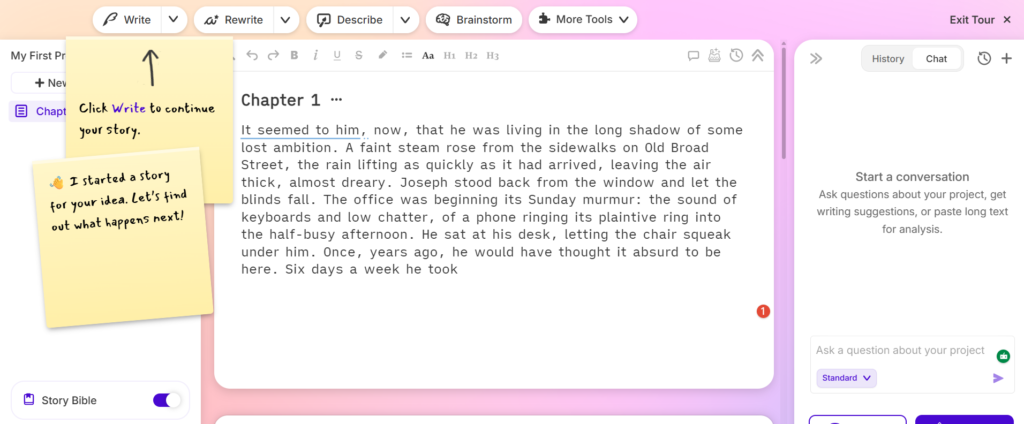
Technically, it is impressive. It can produce evocative imagery. It can suggest metaphors. It can shift tone. It can introduce unexpected turns. But technical capability is not the same as literary necessity. Sudowrite does not decide what matters in your story. It only offers possibilities. And possibilities are not the same as choices.
3. Where It Helps
There are moments in literary writing when paralysis sets in. A scene feels flat. A character refuses to deepen. A paragraph seems thin, underdeveloped, and skeletal. In these moments, Sudowrite can function as a catalyst, which means it can stimulate or accelerate the creative process.
It can:
- Break creative paralysis by offering alternative angles
- Expand a sparse draft into something more textured
- Suggest sensory layers the writer had overlooked
- Generate unexpected associations that spark new thinking
Used this way, it becomes less a substitute and more a provocation.
Sometimes a writer is not blocked by lack of imagination but by over-control. Sudowrite can introduce looseness. It can surprise the writer. It can reveal narrative possibilities that the writer may not have consciously explored.
There is value in that.
Imagination is not a closed system. It has always drawn from outside stimuli—conversations, books, memories, and fragments overheard in passing. Sudowrite can become another form of stimulus.
The key difference is awareness.
When used deliberately, it does not replace imagination. It interacts with it.
But this interaction must be carefully timed.
4. Where It Interferes
The danger is subtle.
Sudowrite generates language that often feels polished. Balanced. Expressive. Beautiful.
But literary voice is not born out of balance.
It often emerges from tension, obsession, and repetition. From sentences that feel slightly off but cannot be abandoned. It often arises from rhythms that resist a neat resolution.
When Sudowrite is introduced too early, it can smooth what should remain jagged.
It can standardize imagination.
AI models are trained on patterns. They recognize what “sounds literary.” They reproduce structures that resemble depth. But resemblance is not the same as lived intensity.
The risk is that the writing becomes acceptable. This is often how writing becomes acceptable.
The risk is that it becomes beautifully hollow.
A paragraph can read elegantly while carrying no urgency. A scene can shimmer without necessity. Literary writing depends not only on description but also on insistence—the sense that this sentence had to be written.
Tools do not experience insistence.
They generate coherence.
There is also the temptation to over-polish fragile ideas. Some thoughts require time to remain awkward. Their unfinished state carries meaning. Refining them too quickly may erase what made them alive.
Necessary struggle is not inefficiency. It is in formation.
If removed prematurely, the voice may begin to flatten.
5. The Question of Identity
Does using Sudowrite dilute authorship?
The question is not simple.
Authorship has never meant isolation. Writers borrow, absorb, and echo. Influence is inevitable. Tools have always existed—dictionaries, thesauruses, writing workshops, and editorial feedback.
Sudowrite is different because it intervenes at the generative level.
It can propose not just corrections but creative directions.
The real question is not whether authorship disappears.
It is whether the writer remains the final authority.
Identity in literature does not come from flawless execution. It comes from selective insistence. This is achieved by repeatedly revisiting specific themes. From tolerating ambiguity. This involves allowing imperfection to persist.
Tools cannot carry obsession.
They cannot replicate lived memory.
They cannot understand why a particular image refuses to leave a writer’s mind.
If Sudowrite begins to decide what is “better,” identity weakens. If the writer uses it as material rather than instruction, identity may even sharpen.
Conscious limits clarify authorship.
Unconscious dependence dissolves it.
The difference lies not in the tool, but in the boundary.
6. A Conscious Hybrid Model
Literary writing in the age of AI requires order.
Not prohibition. Not rejection. But order.
A possible framework might look like this:
1. The idea forms in solitude.
No assistance. No expansion. Only the raw impulse.
2. The first draft remains raw.
Awkward sentences stay awkward. Repetition is allowed. Tension is preserved.
3. The tool enters only after intent is clear.
Sudowrite can then help explore variations, deepen atmosphere, and test alternative emotional directions.
4. Final decisions remain human.
The writer chooses what stays. The writer rejects what feels too smooth. The writer protects necessary friction.
The sequence matters.
If the tool enters before intent solidifies, it risks shaping the story’s bones. If it enters later, it becomes a lens rather than a blueprint.
Restraint becomes the central skill.
Literary writing does not benefit from maximum optimization. It benefits from selective refinement.
The writer must ask:
Am I using this suggestion because it feels true?
Or because it sounds impressive?
The difference is subtle. But it is decisive.
7. Closing Reflection
Literature does not survive because it is efficient.
It survives because someone insists on meaning.
Difficulty once enforced that insistence. It slowed writers down. It filtered out casual impulses. It gave voice to something earned through friction.
Now that friction has softened.
Sudowrite and tools like it remove visible barriers. They make creative expansion accessible. They make language flow more easily. They make possibility abundant.
But abundance is not the same as depth.
Literature still demands dwelling in the unknown. It still asks for patience with imperfection. It still requires the courage to leave certain edges intact.
Tools may assist.
They may even inspire.
But they do not choose what must exist.
That choice remains human. The age of AI no longer protects literary voice from difficulty. It survives because the writer decides to protect it. And that decision cannot be automated.